Hotel Pricing Mistakes That Reduce Revenue: How Hotels Can Maximize Profit with Data-Driven Pricing
Introduction
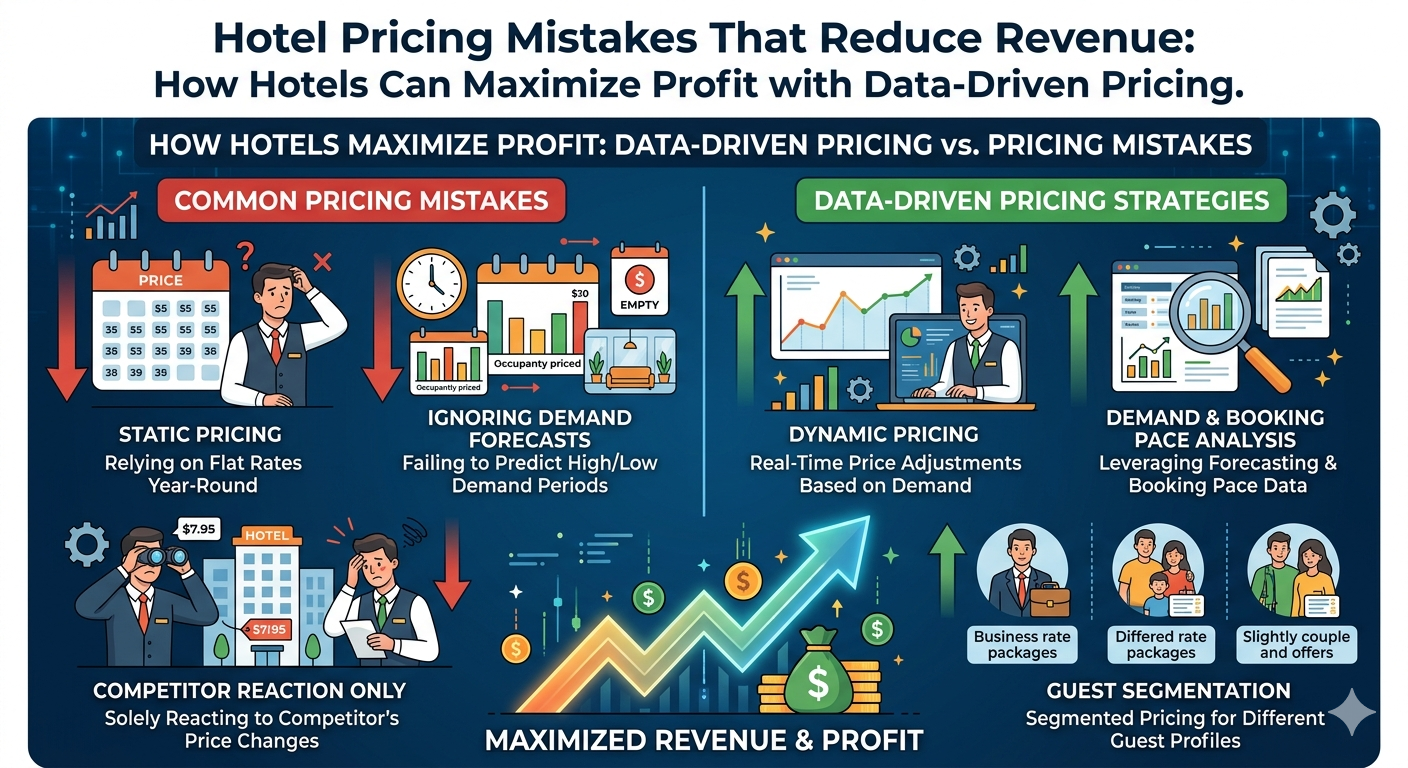
Pricing is one of the most important factors influencing a hotel's revenue performance. Even small pricing mistakes can significantly impact occupancy, profitability, and overall market competitiveness. In today's highly competitive hospitality industry, hotels must move beyond guesswork and adopt data-driven pricing strategies supported by hotel analytics software and revenue management tools.
Many hotels unknowingly lose revenue because of outdated pricing methods, poor market analysis, and a lack of real-time competitive intelligence. Whether operating a boutique hotel, resort, business hotel, or luxury property, understanding common pricing mistakes can help improve occupancy rates, increase Revenue Per Available Room (RevPAR), and maximize profitability.
This guide explores the most common hotel pricing mistakes and explains how hotel analytics tools can help properties make smarter revenue decisions.
Why Hotel Pricing Mistakes Matters
Hotel pricing directly affects:
Occupancy rates
Average Daily Rate (ADR)
Revenue Per Available Room (RevPAR)
Profit margins
Guest acquisition costs
Market competitiveness
An effective pricing strategy balances room demand with revenue goals. Setting prices too high may reduce bookings, while setting them too low can leave significant revenue on the table.
Modern hotel revenue management software helps hotels identify the optimal room rate based on market conditions, demand patterns, and competitor pricing.
Mistake #1: Using Static Pricing Throughout the Year
One of the most common pricing mistakes is keeping room rates unchanged regardless of market conditions.
Many hotels establish rates at the beginning of the year and make only occasional adjustments. However, hotel Occupancy demand constantly changes due to seasons, events, holidays, economic conditions, and traveler behavior.
Why It Hurts Revenue
Static pricing can lead to:
Lost revenue during high-demand periods
Lower occupancy during slow seasons
Reduced competitiveness
Missed pricing opportunities
Better Approach
Implement dynamic pricing supported by hotel analytics software. Dynamic pricing allows hotels to adjust room rates based on:
Occupancy levels
Market demand
Competitor pricing
Local events
Booking pace
This approach helps maximize revenue across all market conditions.
Mistake #2: Ignoring Competitor Pricing Trends
Hotels often focus only on their own rates without monitoring what competitors are charging.
Guests frequently compare room rates across multiple booking platforms before making a reservation. If a hotel's pricing is significantly higher or lower than comparable properties, revenue opportunities may be lost.
Why It Hurts Revenue
Without competitor analysis, hotels may:
Overprice rooms and lose bookings
Underprice rooms and lose revenue
Miss market opportunities
Struggle to maintain competitive positioning
Better Approach
Use competitor rate intelligence tools and hotel market intelligence software to monitor:
Daily competitor pricing
Rate changes
Promotional offers
Occupancy patterns
Real-time competitive insights help hotels make informed pricing decisions.
Mistake #3: Failing to Use Demand Forecasting
Many hotels make pricing decisions based on historical performance alone.
While historical data is valuable, it cannot accurately predict future demand without considering current market conditions.
Why It Hurts Revenue
Poor forecasting can result in:
Excess inventory during slow periods
Underpriced rooms during peak demand
Revenue loss
Inefficient resource planning
Better Approach
Use hotel demand forecasting tools that analyze:
Booking trends
Market demand
Seasonal patterns
Local events
Traveler behavior
Demand forecasting enables proactive pricing decisions rather than reactive adjustments.
Mistake #4: Over-Reliance on OTA Pricing
Many hotels allow Online Travel Agencies (OTAs) to dictate their pricing strategy.
While OTAs pricing competition help generate bookings, depending entirely on OTA pricing can reduce profitability and limit pricing flexibility.
Why It Hurts Revenue
Over-reliance on OTAs can lead to:
High commission expenses
Lower direct booking revenue
Reduced pricing control
Profit margin erosion
Better Approach
Hotels should develop an independent pricing strategy supported by:
Hotel analytics platforms
Revenue management software
Market intelligence tools
Direct booking optimization
Maintaining pricing control helps improve profitability and reduce dependency on third-party channels.
Mistake #5: Offering Excessive Discounts
Discounting is often used to increase occupancy during slow periods.
However, frequent discounting can create long-term pricing problems.
Why It Hurts Revenue
Excessive discounts may:
Lower average room rates
Reduce brand value
Encourage price-sensitive customers
Decrease profitability
Better Approach
Instead of lowering rates dramatically, create value-added packages such as:
Complimentary breakfast
Airport transfers
Room upgrades
Flexible check-in options
Guests often respond positively to added value rather than deep discounts.
Mistake #6: Not Segmenting Customers
Many hotels apply the same pricing strategy to all guests.
Different traveler segments have different booking behaviors, budgets, and expectations.
Why It Hurts Revenue
Uniform pricing can:
Miss revenue opportunities
Reduce conversion rates
Limit upselling potential
Better Approach
Use hotel business intelligence software to segment guests by:
Business travelers
Leisure travelers
Families
Groups
Long-stay guests
Corporate clients
Customized pricing improves both occupancy and revenue performance.
Mistake #7: Ignoring Booking Window Data
Booking windows refer to the time between reservation and arrival.
Understanding booking behavior is critical for revenue optimization.
Why It Hurts Revenue
Hotels that ignore booking windows may:
Miss early booking opportunities
Fail to attract last-minute travelers
Mismanage inventory
Better Approach
Analyze booking trends using hotel booking analytics software.
Track:
Advance booking patterns
Last-minute reservations
Seasonal booking behavior
Cancellation trends
These insights help optimize pricing throughout the booking cycle.
Mistake #8: Not Monitoring Key Revenue Metrics
Many hotels focus solely on occupancy rates.
While occupancy is important, it does not provide a complete picture of revenue performance.
Why It Hurts Revenue
High occupancy does not always mean high profitability.
Hotels may fill rooms at low rates and still generate weak revenue performance.
Better Approach
Monitor critical hotel performance metrics including:
Average Daily Rate (ADR)
Measures average revenue earned per occupied room.
Revenue Per Available Room (RevPAR)
Evaluates overall room revenue performance.
Gross Operating Profit Per Available Room (GOPPAR)
Measures profitability rather than revenue alone.
Occupancy Rate
Tracks room utilization.
Hotel performance analytics software provides visibility into all these metrics.
Mistake #9: Not Responding to Changes in Market Demand
Local events often create significant demand spikes.
Hotels that fail to adjust pricing during these periods lose valuable revenue opportunities.
Why It Hurts Revenue
Underpricing during major events can result in:
Revenue loss
High occupancy with low profitability
Missed premium pricing opportunities
Better Approach
Track:
Conferences
Trade shows
Festivals
Sporting events
Concerts
Holidays
Hotel market intelligence tools can identify upcoming demand drivers and support revenue optimization.
Mistake #10: Relying on Manual Pricing Decisions
Manual pricing is time-consuming and prone to errors.
Market conditions can change rapidly, making manual adjustments difficult to manage consistently.
Why It Hurts Revenue
Manual pricing often leads to:
Delayed responses
Inconsistent pricing
Human error
Lost revenue opportunities
Better Approach
Use automated hotel revenue management software to:
Monitor market trends
Track competitor pricing
Forecast demand
Recommend optimal room rates
Automation enables faster and more accurate pricing decisions.
The Role of Hotel Analytics Software in Revenue Optimization
Technology plays a critical role in modern hotel pricing strategies.
Advanced hotel analytics software transforms large volumes of data into actionable insights that support revenue growth.
Key Features of Hotel Analytics Tools
Competitor rate monitoring
Revenue forecasting
Occupancy analytics
Market intelligence
Performance reporting
Dynamic pricing recommendations
Booking trend analysis
These capabilities help hotels make smarter pricing decisions based on real-time market conditions.
Benefits of Data-Driven Pricing
Hotels that adopt data-driven pricing strategies often experience measurable improvements in performance.
Increased Revenue
Optimized room rates maximize revenue opportunities.
Higher Occupancy
Competitive pricing attracts more bookings.
Improved RevPAR
Better pricing decisions increase revenue per available room.
Enhanced Market Position
Hotels remain competitive in changing market conditions.
Better Forecast Accuracy
Predictive analytics improve planning and decision-making.
Essential Hotel Analytics Metrics for Revenue Success
To maximize pricing performance, hotels should regularly monitor:
Occupancy Rate
ADR (Average Daily Rate)
RevPAR (Revenue Per Available Room)
GOPPAR
Booking Conversion Rate
Competitor Pricing Index
Direct Booking Ratio
Channel Performance
Cancellation Rate
Market Share
Hotel business intelligence platforms provide centralized access to these critical performance indicators.
Future Trends in Hotel Pricing
The hospitality industry is becoming increasingly data-driven.
Hotels are adopting advanced technologies such as:
Artificial Intelligence pricing engines
Predictive analytics
Automated revenue management
Real-time competitor intelligence
Demand forecasting software
These innovations enable hotels to respond quickly to market changes and maximize revenue opportunities.
Properties that embrace modern hotel analytics solutions are better positioned for long-term growth and profitability.
Conclusion
Hotel pricing mistakes can significantly reduce revenue, occupancy performance, and profitability. Common issues such as static pricing, poor forecasting, excessive discounting, and lack of competitor analysis often prevent hotels from achieving their full revenue potential.
By leveraging hotel analytics software, hotel revenue management software, hotel market intelligence tools, and hospitality business intelligence platforms, hotels can make data-driven pricing decisions that improve ADR, RevPAR, occupancy, and overall profitability.
Successful revenue management is no longer based on intuition alone. Hotels that use real-time analytics, dynamic pricing, and demand forecasting gain a competitive advantage and create sustainable revenue growth in an increasingly competitive hospitality market.