How to Beat OTA Pricing Competition: Smart Strategies for Hotels to Increase Direct Bookings
Introduction
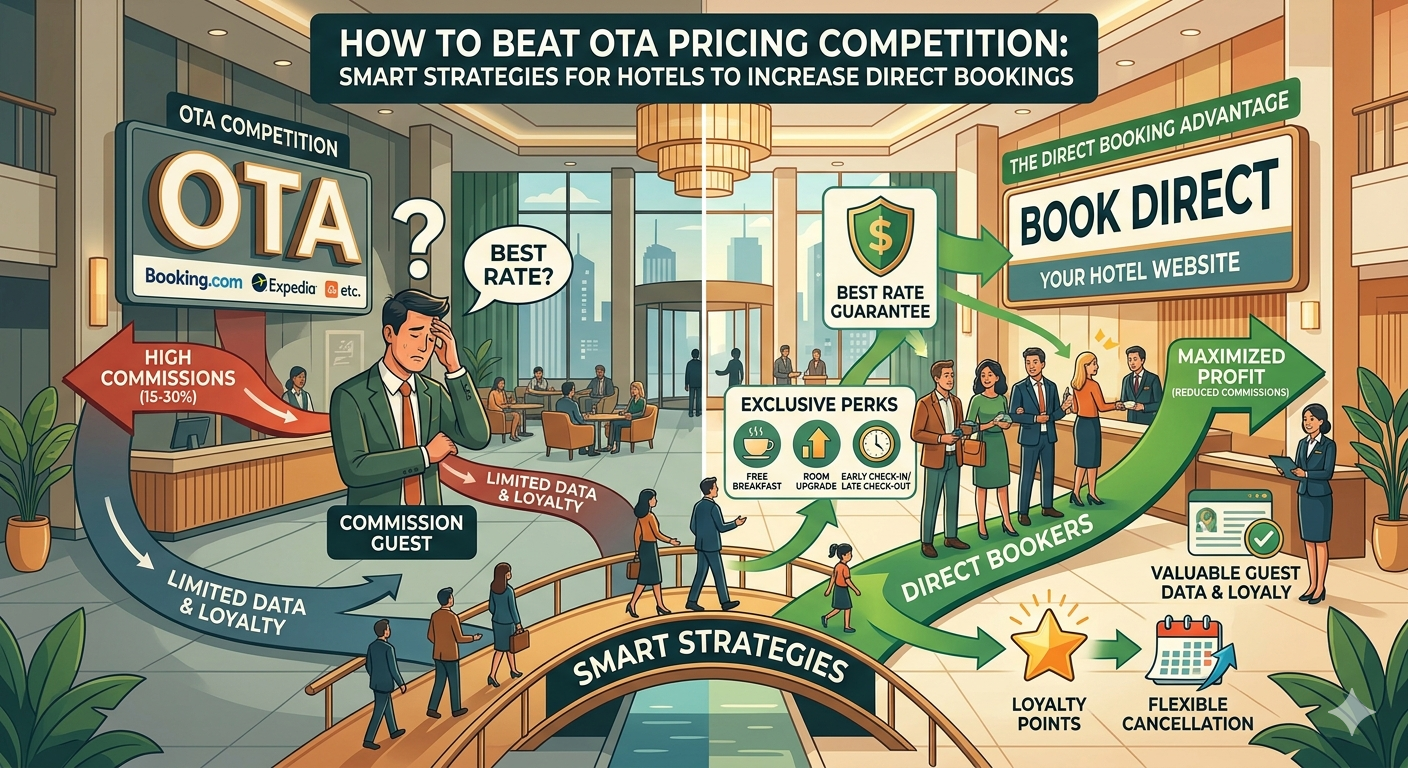
However, competing with OTA pricing competition and commission structures can be challenging for hotels looking to maximize revenue and increase direct bookings.
The key to beating OTA pricing competition is not always offering the lowest rate. Instead, hotels can use data-driven pricing strategies, hotel analytics software, and revenue management tools to create a competitive advantage while maintaining profitability.
Why OTA Pricing Competition Is a Challenge for Hotels
OTAs invest heavily in digital marketing, search engine visibility, and customer acquisition. As a result, travelers often compare hotel prices across multiple platforms before making a booking decision.
Common challenges include:
High commission fees
Price comparison pressure
Reduced direct bookings
Lower profit margins
Limited customer ownership
To overcome these challenges, hotels need access to real-time market insights and hotel business intelligence.
Monitor Competitor Rates in Real Time
One of the most effective ways to stay competitive is by tracking competitor pricing continuously.
Using hotel analytics software, hotels can monitor:
Competitor room rates
Occupancy trends
Seasonal demand fluctuations
Market positioning
Pricing opportunities
Real-time hotel rate intelligence helps revenue managers make informed pricing decisions instead of relying on guesswork.
Benefits of Competitor Rate Monitoring
Identify pricing gaps quickly
Adjust room rates dynamically
Improve revenue performance
Stay competitive across all booking channels
Implement Dynamic Pricing Strategies
Static pricing often results in lost revenue opportunities. Dynamic pricing allows hotels to adjust rates based on market demand, competitor activity, booking pace, and occupancy levels.
A hotel revenue management system can automatically recommend optimal pricing based on live market data.
Dynamic Pricing Factors
Local events
Holidays and festivals
Booking lead time
Occupancy forecasts
Competitor pricing trends
Hotels that use dynamic pricing typically achieve better occupancy rates and improved Revenue Per Available Room (RevPAR).
Focus on Value Instead of Price Wars
Competing solely on price can reduce profitability. Instead, hotels should create additional value for direct bookings.
Consider offering:
Complimentary breakfast
Free airport transfers
Early check-in or late check-out
Room upgrades
Loyalty rewards
Guests often choose added benefits over small price differences.
Use Hotel Analytics Software for Smarter Decisions
Modern hotel analytics platforms provide valuable insights into market performance and pricing trends.
A comprehensive hotel analytics dashboard can help hotels:
Track competitor rates
Analyze occupancy performance
Monitor Average Daily Rate (ADR)
Measure RevPAR growth
Forecast future demand
By leveraging hotel analytics software tools, hotels can optimize pricing strategies and improve revenue outcomes.
Key Metrics to Monitor
Occupancy Rate
ADR (Average Daily Rate)
RevPAR (Revenue Per Available Room)
Market Share
Booking Conversion Rate
Direct Booking Ratio
Strengthen Your Direct Booking Strategy
Increasing direct bookings reduces dependency on OTAs and improves profitability.
Effective strategies include:
Optimize Hotel Website Performance
Ensure your website offers:
Fast loading speed
Mobile-friendly design
Secure booking engine
Simple reservation process
Improve Search Visibility
Invest in hotel SEO strategies to attract travelers searching directly for accommodation.
Target keywords such as:
Hotel booking analytics
Hotel revenue management software
Hotel market intelligence platform
Hotel performance analytics
Hospitality business intelligence
Build Guest Loyalty
Encourage repeat bookings through:
Exclusive member rates
Loyalty programs
Personalized offers
Email marketing campaigns
Leverage Demand Forecasting and Market Intelligence
Accurate forecasting helps hotels anticipate market changes and adjust pricing proactively.
Hotel demand forecasting tools can identify:
High-demand periods
Low-occupancy dates
Emerging travel trends
Competitor movements
This allows hotels to make revenue-focused decisions before market conditions change.
Advantages of Hotel Market Intelligence
Better pricing accuracy
Increased occupancy
Improved revenue planning
Stronger competitive positioning
Track OTA Performance and Booking Trends
Hotels should regularly analyze OTA pricing competition performance rather than relying on assumptions.
Important metrics include:
OTA booking share
Commission costs
Booking source performance
Channel profitability
Guest acquisition costs
Hotel business intelligence software provides detailed reports that help identify the most profitable distribution channels.
Automate Revenue Management Processes
Manual pricing management becomes difficult as market conditions change rapidly.
Revenue management automation enables hotels to:
Monitor competitor pricing
Update room rates automatically
Generate forecasting reports
Improve pricing accuracy
Reduce operational workload
Automation allows hotel teams to focus on strategic growth initiatives rather than repetitive tasks.
The Role of Hotel Analytics in Competitive Pricing
Hotels that rely on data outperform those that depend on intuition alone. Advanced hotel analytics tools provide actionable insights that help hotels respond quickly to market shifts and OTA pricing competition.
With the right hotel analytics software, hotels can:
Optimize room pricing
Increase direct bookings
Improve occupancy rates
Reduce OTA dependency
Maximize overall revenue
Data-driven decision-making creates a sustainable competitive advantage in today's hospitality market.
Conclusion
Beating OTA pricing competition is not about offering the lowest room rate. Success comes from leveraging hotel analytics software, revenue management tools, competitor rate intelligence, and demand forecasting to make smarter pricing decisions.
Hotels that adopt a data-driven approach can improve profitability, strengthen direct booking channels, and maintain a competitive position against major travel platforms. By combining market intelligence, dynamic pricing, and guest-focused value offerings, hotels analytics can reduce OTA Pricing competiton dependence and achieve long-term revenue growth