How Hotel Competitor Analytics Help Increase Direct Bookings
The hotel industry has become more competitive than ever before. Travelers now compare prices, reviews, amenities, and booking options across multiple websites before making a reservation. In this fast-moving digital environment, hotels are constantly searching for smarter ways to increase direct bookings and reduce dependency on Online Travel Agencies (OTAs).
While OTAs help hotels gain visibility, they also charge high commission fees that reduce profit margins. Because of this, many hotels are focusing on strategies that encourage guests to book directly through their websites. One of the most effective ways to achieve this is by using hotel competitor analytics.
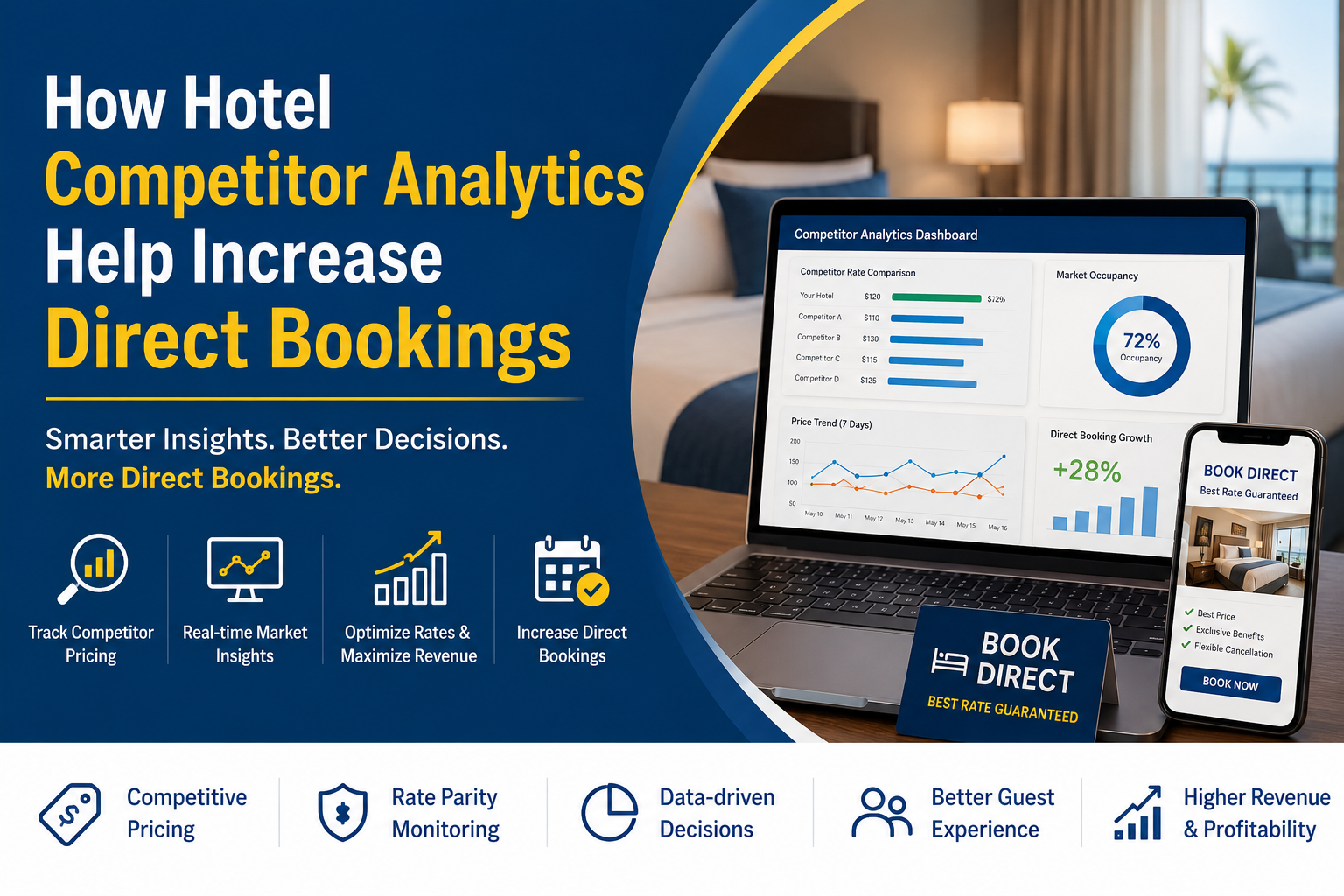
Hotel competitor analytics helps hotels understand market trends, monitor competitor pricing, analyze customer behavior, and improve booking strategies. Instead of making pricing decisions based on assumptions, hotels can use real-time data and insights to attract more guests directly to their own booking platforms.
Modern hotel analytics tools are transforming the hospitality industry by helping hotels optimize rates, improve online visibility, maintain competitive pricing, and deliver better guest experiences. These factors play a major role in increasing direct bookings and maximizing hotel revenue.
What Is Hotel Competitor Analytics?
Hotel competitor analytics refers to the process of collecting and analyzing competitor hotel data to improve pricing, marketing, and revenue strategies. It gives hotels insights into how competing properties are performing in the market.
Competitor analytics tools can track:
Room pricing across OTAs
Occupancy trends
Rate parity issues
Seasonal pricing changes
Customer reviews
Booking trends
Market demand fluctuations
Promotional strategies
With this information, hotels can identify opportunities to improve their own pricing and booking strategies.
Instead of reacting late to market changes, hotels can make proactive decisions that help them stay competitive and attract more direct reservations.
Why Direct Bookings Matter for Hotels
Direct bookings are one of the most valuable revenue sources for hotels. When guests book directly through a hotel website, the hotel avoids paying large commissions to OTAs.
Direct bookings provide several benefits:
Higher profit margins
Better guest relationships
More customer data access
Increased brand loyalty
Improved upselling opportunities
Greater pricing control
Hotels that depend heavily on OTAs often struggle with reduced profits because commission charges can significantly impact overall revenue.
By increasing direct bookings, hotels gain more control over customer interactions and revenue management.
This is why many hotels are investing in competitor analytics and pricing intelligence tools to improve their direct booking performance.
How Hotel Competitor Analytics Improves Direct Bookings
Better Pricing Strategies
Pricing is one of the most important factors that influence hotel bookings. Travelers compare hotel room prices across multiple websites before choosing where to stay.
If a hotel’s pricing is too high compared to competitors, guests may book elsewhere. If pricing is too low, the hotel may lose potential revenue.
Hotel competitor analytics helps hotels maintain balanced and competitive pricing.
By monitoring competitor rates in real time, hotels can:
Adjust prices instantly
Identify pricing gaps
Offer better value
Respond to market demand faster
When guests find competitive prices directly on the hotel website, they are more likely to book without using OTAs.
Smart pricing strategies increase trust and encourage direct reservations.
Maintaining Rate Parity Across Channels
Rate parity means maintaining consistent room prices across all booking platforms.
If travelers discover lower prices on OTAs than on the hotel website, they are less likely to book directly.
Hotel competitor analytics tools can monitor:
OTA pricing differences
Unauthorized discounts
Third-party rate undercutting
Channel pricing inconsistencies
By identifying these issues quickly, hotels can correct pricing discrepancies and maintain competitive direct booking rates.
Consistent pricing builds customer confidence and improves conversion rates on hotel websites.
Understanding Competitor Promotions
Competitor analytics tools also help hotels track promotional campaigns used by competing properties.
Hotels can analyze:
Seasonal offers
Weekend discounts
Holiday packages
Early booking promotions
Last-minute deals
Understanding competitor promotions helps hotels create stronger direct booking campaigns that attract travelers.
For example, if nearby competitors are offering free breakfast or discounted packages, a hotel can introduce unique direct booking incentives such as:
Free room upgrades
Flexible cancellation
Complimentary airport pickup
Exclusive member discounts
Loyalty rewards
These strategies encourage travelers to choose direct booking channels instead of OTAs.
Improving Hotel Website Conversion
Direct bookings depend heavily on website performance. Even if pricing is competitive, travelers may leave the website if the booking experience is poor.
Competitor analytics helps hotels understand industry trends and customer expectations.
Hotels can improve website conversion by analyzing:
Booking flow simplicity
Mobile optimization
Page loading speed
Pricing presentation
Promotional visibility
By studying competitor strategies, hotels can optimize their websites to provide a smoother booking experience.
A user-friendly website with clear pricing and attractive offers increases direct booking conversions significantly.
Enhancing Revenue Management
Revenue management is no longer limited to adjusting prices occasionally. Modern hotel revenue management depends on continuous market analysis and real-time competitor monitoring.
Hotel competitor analytics supports revenue management by providing insights into:
Market demand changes
Occupancy forecasts
Competitor rate fluctuations
Booking pace trends
Seasonal travel patterns
With this information, hotels can create dynamic pricing strategies that maximize both occupancy and profitability.
When hotels maintain optimal pricing, travelers are more likely to book directly instead of continuing to compare options elsewhere.
Building Customer Trust
Trust plays a major role in direct bookings.
Travelers often check multiple websites to confirm whether they are getting the best available price. If the hotel website provides transparent pricing and better booking benefits, customers feel more confident booking directly.
Competitor analytics helps hotels maintain market credibility by ensuring that their pricing remains competitive and fair.
Hotels can also use competitor insights to improve their reputation management strategies.
Monitoring competitor reviews helps hotels identify areas where they can offer a better guest experience.
Positive guest experiences lead to:
Better reviews
Repeat bookings
Stronger brand reputation
Increased customer loyalty
All of these factors contribute to higher direct booking growth.
Reducing OTA Dependency
Many hotels struggle with overdependence on OTAs. While OTAs provide visibility, relying too heavily on them can hurt profitability.
Hotel competitor analytics helps hotels gradually shift bookings toward direct channels.
By improving pricing accuracy, promotional strategies, and customer engagement, hotels can encourage travelers to book directly instead of through third-party platforms.
Reducing OTA dependency also gives hotels more control over:
Guest communication
Marketing campaigns
Pricing strategies
Customer relationships
This creates long-term business stability and higher revenue retention.
Real-Time Market Intelligence
The hospitality market changes rapidly. Events, holidays, weather conditions, and travel trends can affect hotel demand instantly.
Competitor analytics tools provide real-time market intelligence that helps hotels react quickly.
For example:
If competitors suddenly increase prices during a local event, hotels can adjust rates immediately.
If demand drops unexpectedly, hotels can launch promotional offers quickly.
If occupancy levels rise, hotels can maximize revenue through dynamic pricing.
Real-time data helps hotels stay competitive and capture more direct bookings during important market opportunities.
The Role of AI in Hotel Competitor Analytics
Artificial Intelligence is becoming an important part of hotel analytics platforms.
AI-powered systems can analyze large amounts of data and provide actionable recommendations automatically.
Modern hotel analytics platforms use AI for:
Dynamic pricing suggestions
Demand forecasting
Booking trend analysis
Competitor monitoring
Revenue optimization
AI helps hotels make faster and more accurate decisions.
Instead of manually checking competitor prices every day, hotels can rely on automated systems that continuously monitor the market and recommend the best pricing strategies.
This improves operational efficiency and supports direct booking growth.
Why Manual Competitor Tracking Is No Longer Enough
Some hotels still use spreadsheets or manual OTA checks to monitor competitors. However, manual tracking has several limitations.
It is:
Time-consuming
Inaccurate
Difficult to scale
Unable to provide real-time insights
Hotel prices can change several times per day. Manual monitoring cannot keep up with such rapid market changes.
Automated hotel competitor analytics platforms solve this problem by collecting and analyzing data continuously.
Hotels receive faster insights, better accuracy, and improved decision-making capabilities.
Future of Hotel Competitor Analytics
The future of hotel competitor analytics is becoming increasingly advanced and data-driven.
Emerging trends include:
Predictive pricing analytics
AI-powered revenue management
Real-time demand forecasting
Personalized guest targeting
Automated competitor benchmarking
Smart hotel business intelligence dashboards
Hotels that adopt intelligent analytics solutions early will gain a strong competitive advantage in the hospitality industry.
As traveler expectations continue to evolve, hotels must rely on data and technology to remain competitive and increase direct bookings.
Conclusion
Hotel competitor analytics has become an essential tool for modern hotels that want to increase direct bookings and reduce OTA dependency.
By monitoring competitor pricing, analyzing market trends, improving revenue management, and maintaining rate parity, hotels can attract more travelers directly through their own booking platforms.
Competitor analytics not only improves pricing decisions but also helps hotels build stronger customer relationships, increase profitability, and improve market positioning.
In today’s competitive hospitality industry, relying on guesswork is no longer enough. Hotels need real-time data, intelligent insights, and smart pricing strategies to succeed.
Hotels that invest in competitor analytics technology can create better guest experiences, strengthen direct booking performance, and achieve long-term revenue growth in an increasingly digital travel market.